Decision models,
put to work.
Give your agent the methods to find a useful judgment, build the policy and evals around it, and improve against real outcomes.
/01 — A decision, taken apart
A refund request is not refund authority.
Illustrative design.
Not measured performance.
-
Observed evidence
The request
“I was charged twice.”
No order ID is included. The customer’s message is evidence of intent, not proof of a duplicate charge.
-
Model judgment
Identify intent
Choose a known category or abstain. Recognizing a refund request does not establish which charge is eligible.
Output: a category, not permission.
-
Explicit policy
Hold the action
A missing order ID requires authenticated lookup or a question to the customer. Do not guess the target.
-
Code + authorized owner
Check before paying
Verify ownership, eligibility, amount, permissions, prior refunds, and idempotency before any refund executes.
What would reject this design?
Compare false refunds, missed requests, review load, latency, and total cost with the current baseline on held-out cases. Read the full design card.
/02 — Applications
Bring a decision.
Leave with a system.
Augustus is a skill and method engine, not a hosted runtime. Agents use it across software, business, organizations, and everyday decisions.
Advice produces a design card. Build requests produce working policy and evals. Improvement requests produce a bounded, outcome-tested iteration.
Explore six model placements- Route, rank, or classify
- Put a narrow judgment inside a workflow whose permissions, exact work, and fallback remain explicit.
- Train your own task specialist
- Choose primitives, base models and methods. Assemble data, fit and export a component, and test it against the incumbent.
- Improve a Software 3.0 system
- Compose decision models, run bounded prompt or program hill climbing, and confirm gains on protected evidence.
- Make a human tradeoff legible
- Connect uncertain evidence to explicit criteria and constraints. Keep values and the final decision with people.
/03 — Film
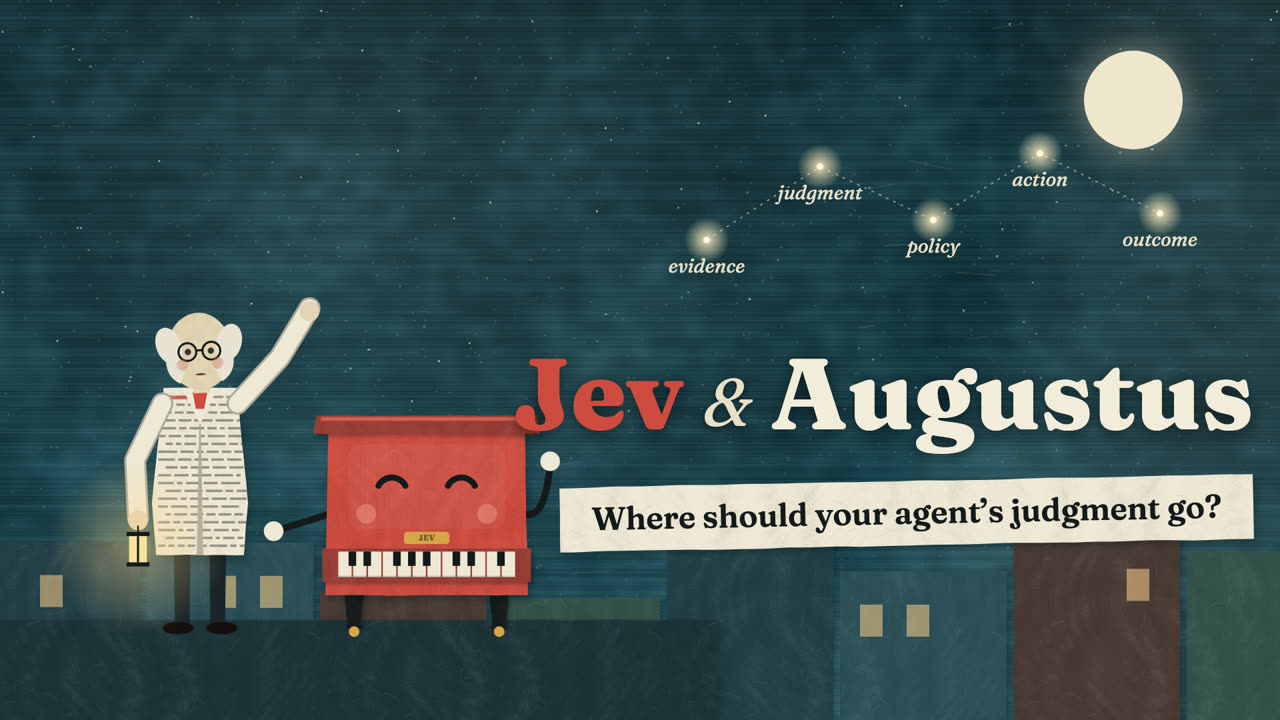
The story of Jev and Augustus.
In 1869, Jevons built a piano that played logic. His teacher De Morgan taught that you draw the boundary before you reason. This short film follows that idea to today’s agents: where a bounded judgment belongs, what stays in code, how Augustus tests the change against your current workflow, and how augustus-train helps you build and test a task specialist of your own.
Read the transcript
London, 1869. A young economist named William Stanley Jevons builds a piano that plays no music at all. It plays logic.
You press in your premises, key by key, and the machine quietly throws out every combination that contradicts them. Whatever is left is what can still be true.
Jevons learned his logic from Augustus De Morgan, who taught that before you reason about anything, you draw a boundary around it: the universe of discourse. Say what you’re asking. Say what the answer is allowed to be.
A hundred and fifty-seven years later, your agent has the opposite problem. Every small call… is this email a refund request? Is this task actually done? …goes to a giant model that writes back a paragraph of JSON. Slow, expensive, and never quite the same answer twice.
Jev is a different kind of model. It answers bounded questions, and nothing else. A Choice picks one of the options you offer. A Score rates something against levels you describe. A Noul asks: is this statement true? And returns a probability.
But a precise tool in the wrong place is still the wrong tool. Which step gets the judgment? What stays in code? And what happens when the right answer is… none of the above?
That’s the job of Augustus: a skill for your coding agent, named for the teacher. It walks your workflow and sorts every step. Exact work stays in code. Open-ended writing stays with the generator. Only bounded judgment goes to the decision model, and an explicit policy decides what actually happens.
Then it checks the work, because a typed answer isn’t a true answer. Augustus keeps “none” on the menu, tests against the workflow you already have on cases the model has never seen, and names the result that would prove the idea wrong. If the new version loses, you keep the old one.
And when no hosted model fits, the companion skill, Augustus Train, helps you build a task specialist of your own. It picks a primitive and a base model that fit your costs and data, assembles labeled records with their provenance, and keeps confirmation data sealed. It trains, exports, and reloads the model in a fresh process. Then it improves it in bounded steps, against the incumbent.
And sometimes the best answer is a formula, a checklist, or no new model at all. It’ll tell you that, too.
Augustus. Evidence, judgment, policy, action, outcome. One line to install. Then ask your agent where the judgment belongs.
/04 — Installation
Put it in your agent’s hands.
Both skills need no API key. Calling a hosted model is a separate, optional integration.
Current release: 0.8.1. These commands install both Augustus and Augustus Train from the release tag.
/05 — First prompt
Start with one real workflow.
Use Augustus to audit our refund-email workflow. Test whether a classifier helps, keep eligibility and payments in code, and build an eval that could reject the change. Keep the current baseline if it works better.
Bring your evidence, constraints, and current baseline. See the expected design card or report a confusing recommendation.
/06 — Reference
The method stays inspectable.
Mathematical and scientific methods provide structure; real outcomes decide which compositions survive. Research is evidence to reason from, not a catalog to imitate.
TypeSafe Jev Choice/Score/Noul is the default hosted exemplar, not the whole class. Augustus is an independent project, not a TypeSafe product.
- Read the skillThe agent’s entry point
- Methods and compositionFocused implementation guidance
- Decision-model ecosystemFamilies, contracts, and evidence
- Research archiveSources, revisions, and reassessment